(ALL DIGITAL PICTURES ON THIS PAGE HAVE NO COPYRIGHT, PLEASE DOWNLOAD AND SHARE TO THE GLORY OF GOD)
SCROLL DOWN TO THE BOTTOM OF THIS PAGE FOR OUR HI-RESOLUTION PICTURES
And our NEW 2026 Calendar with some outstanding pictures can be found HERE
Many of you have asked for metal prints of our heavenly images. They can be found HERE
We have three articles so far in the Psalm 19 Project series and a full length podcast interview. The first article is down below and gives the background for this project.
For the other articles in this series see these links.
Part 2- Addressing Flat Earth Claims
https://prophecywatchers.com/psalm-19-project-addressing-flat-earth-claims/
Part 3- What is the Expanse/Firmament (Raqia)?
https://prophecywatchers.com/psalm-19-project-what-is-the-expanse-firmament-raqia/
Part 4- What Can we Learn from Eclipses and Signs in the Heavens?https://prophecywatchers.com/eclipse/
PODCAST– For a full length discussion on the various facets of the flat earth theory, please check out the following link (https://prophecywatchers.com/flat-earth/) where I discuss the reality of the expansive heavens and an examination of the flat earth model compared with our Psalm 19 Project observations. I also addresses what the Bible does and doesn’t say about the shape of the earth.
https://prophecywatchers.com/flat-earth/
Part 1- What is the Psalm 19 Project?
As we continue to make known the excellent teachings of many Bible prophecy experts for the sake of reaching people with the gospel and the truth of God’s Word, God is creating other opportunities to promote and defend the gospel. As many of you know and have seen, we are continuing to use archaeology to share the amazing truths of how archaeology demonstrates the reliability of the Bible. Like fulfilled prophecy, God has used archaeology to equip His people to reach many with the saving gospel of Jesus Christ. What many might not know is that in the last year God has been opening doors not only to discuss archaeology, but also to do archaeology. Our archaeological “arm” of Prophecy Watchers involves several behind the scenes projects which require much care and caution. We are in the process of receiving funds in order to purchase a Ground Penetrating Radar (GPR) system which will be used in our efforts. We are almost there and look forward to seeing how God uses this advanced technology to strengthen our ministry goals. Maybe we call this the Job 12:8 Project. 😊
This brings us to another project God has been stirring in our hearts since 2021. Gary and I have many common interests and one of the first ones that we enjoyed discussing and dreaming about was astronomy. Gary is a pilot and used to write the technical manuals for Cessna aircraft. His brain is wired as a scientist and so he has long been drawn to study the scientific nature of the Bible. I took astronomy in college and have owned several small to medium sized telescopes through the years. On a side note, I will combine this with my archaeology background and we will do further work in what is called Archaeoastronomy. This is a field which examines the ways in which archaeological monuments and structures are aligned with the stars, sun, and moon (think Stonehenge at the winter/summer solstices or spring/fall equinoxes). This is consistent with our desire to research and evaluate “fringe” topics that often are not addressed by many pastors or scholars. Even though the Bible doesn’t give us all the answers we would like in assessing these other subjects, we do believe that the Bible is the supreme authority and gives us sufficient knowledge to make preliminary evaluations.
As Gary, myself, and Bob have been discussing, we know that the opportunity is there to be on the cutting edge of watching prophetic events unfold. This certainly includes astronomical events. With our love for the gospel and astronomy, God has been guiding us to pursue advanced methods of research and teaching as we watch prophesied events begin to unfold. This is a multi-pronged endeavor which we are calling the Psalm 19 Project.
This project will have several layers to it, but the primary goal is to fulfill the admonition that Peter gives us, “…in your hearts honor Christ the Lord as holy, always being prepared to give a defense to anyone who asks you for a reason for the hope that is in you; yet do it with gentleness and respect” (1 Pet. 3:15). We want everyone to see all of God’s creation be seen for what it does… it gives and proclaims His glory (Psalm 19:1).
The first facet will be to simply share the majesty and glory of all of God’s creation through astrophotography and biblical teaching. God is the creator and Paul teaches us that, “For the wrath of God is revealed from heaven against all ungodliness and unrighteousness of men, who by their unrighteousness suppress the truth. 19 For what can be known about God is plain to them, because God has shown it to them. 20 For his invisible attributes, namely, his eternal power and divine nature, have been clearly perceived, ever since the creation of the world, in the things that have been made. So, they are without excuse” (Rom 1:18-20). This is a sobering passage of Scripture. It tells us that God’s wrath against sin is real and those that are not yet believers are under God’s wrath and need the gospel (John 3:36). Additionally, Paul explains that the creation itself reveals His invisible attributes, namely, God’s power and nature. How powerful is God? What does the creation inform us about God’s nature and qualities? Further, Paul says that mankind is without excuse because God has plainly revealed to all of mankind that He exists. We simply want to remind all of humanity of what God has already shown them, He exists and is amazing in His attributes! God is worthy of our worship and His love for us has been clearly demonstrated through His Son Jesus Christ and His creation (Romans 5:8; John 14:9; Psalm 103:11).
God’s creation is extensively majestic. The Bible is not an astronomy textbook, but God Himself makes reference to certain constellations that have a long history. One of them mentioned, the Pleiades (an asterism known colloquially as the Seven Sisters) appears in Job 9:9; 38:31; and Amos 5:8. God sought to humble Job and asked Him, “Can you bind the cluster of the Pleiades, Or loose the belt of Orion?” These cluster of stars are scientifically proven to be currently gravitationally bound together. How did the writer of the book of Job know this thousands of years before it could be scientifically proven? We know the answer. The Scripture is true and God provides these little nuggets of information to show that the Bible is inspired and trustworthy. This is a picture of the Pleiades star cluster that a friend of mine took recently with his telescope from his backyard in western Idaho (countryastronomer.com). Isn’t it beautiful?

Below is a picture that we took with our new 7″ refractor telescope over a period of 11 hours. Because we spent more time on the object, we were able to see even more detail and the reddish color come through which is from Hydrogen gas which often glows red. The colors look like paint brush strokes. (Click for larger image)

We are going to be spending more time on this topic and also showing the wonders of God’s majestic universe. Why did He make it so big? How large is it? How many stars are there? And how many galaxies? Astronomers still have no idea how extensive God’s universe is. Just when humanity thinks we have answer, we realize that our technology isn’t grand enough to keep up. Back in 1995 Hubble spent 10 days taking a time exposed photo of a dark spot about 1/10 the size of the full moon in the Ursa Major constellation (“Hubble Deep Field”). They figured that since this was one of the darkest places in the heavens, they would simply confirm there was nothing there. They could not have been more wrong! In this extremely small section, they found over 3,000 galaxies. They decided to take another similar sized image again in 2003-4 in the constellation Fornax calling it the “Hubble Ultra Deep Field.” In this so called “dark spot” they found over 10,000 galaxies!
They have continued to use updated information and exposure times to gain more accurate renditions. The “Hubble eXtreme Deep Field” was put together in 2012 which was even smaller, at 80% the size of the Ultra Deep Field (1/32 millionth part of the sky). In the following image they estimate 5500+ galaxies are in view. And even this is limited by the size of Hubble and its exposure time! There are even more recent updates which we will share in upcoming articles. Additionally, the James Webb Telescope is now in orbit and conveys to us that these are exciting times to see the grandeur of God’s creative handiwork.

The second facet recognizes Jesus’ prophetic words that as we get closer to the end of the age, astronomical and cosmic signs will increase in frequency and intensity. Jesus says, “there will be signs in sun and moon and stars, and on the earth distress of nations in perplexity because of the roaring of the sea and the waves, 26 people fainting with fear and with foreboding of what is coming on the world. For the powers of the heavens will be shaken” (Luke 21:25-26). The book of Revelation is replete with evidences that during the tribulation period the very nature of the heavens will be used by God to unequivocally reveal that the judgments occurring in the heavens and on earth are of His orchestration. God is judging rebellious mankind and giving them one final opportunity to repent and trust Jesus. As the wrath of God begins when Jesus opens the first seal of Revelation 6:1, the events unfold and the people of the earth clearly recognize that they are in the wrath of God (Rev 6:12-17). The Bible is full of examples of astronomical events happening during the 7-year tribulation period (Isaiah 13:9-13; 24:17-23; Matt 24:29; Rev 8:12; Joel 2:10-11).
At the same time, we also know that there are some Bible teachers that believe there will be cosmic signs in the heavens before the tribulation begins. Arnold Fruchtenbaum writes, “The first of these five blackouts is clearly prophesied to occur before the Tribulation in Joel 2:31. ‘The sun shall be turned into darkness, and the moon into blood, before the great and terrible day of the LORD comes.’ Again, the term the Day of the LORD is used, which is always a name for the Tribulation. The first blackout is to take place beforehand. So, at some point before the Tribulation, one of these worldwide blackouts will occur” (Footsteps of the Messiah, 130). Not everyone agrees with his perspective, but if he is correct, we need to be ready to document and explain these cosmic signs as the final warning of the impending arrival of the Day of the LORD.
This second facet also involves the recent information being presented by Tom Horn concerning the orbit of the asteroid Apophis which NASA has confirmed will come near earth on April 13, 2029 (as well as 2036 and 2068). Tom Horn is convinced that NASA is not being honest about how close Apophis will come to the earth in 2029. He believes that Apophis will actually make impact with the earth and possibly be the fulfillment of the Wormwood prophecy as found in Revelation 8:11. His documentary, Ragnarök, explains his reasons for believing that Apophis will strike the earth. Amateur astrophotographers are already photographing Apophis. As the asteroid gets even closer, we will be able to photograph it with our Psalm 19 Project equipment and bring some verification to its orbit. We are not in the habit of making predictions, but we are commanded by Jesus to keep watching and to always be ready (Mark 13:37). This we will continue to do by the Lord’s grace.
The Third facet to our new project will also be evangelistic in nature. With access to the internet, the theory that the earth is flat is becoming increasingly pervasive in our culture. You might be asking, “Really? People actually believe the earth is flat?” It is very true as we have people consistently writing in or posting on our social media outlets that we are not “enlightened” since we affirm the earth is a globe. For the most part, these people mean well. Many of them believe the earth is flat based on their interpretation of the Bible. Often, these are people who love Jesus, are saved, but who have become convinced through well produced videos on the internet. One of their assertions is that most pictures you see of the universe, planets, Hubble pics, etc. are fabrications and lies put out by NASA and other global conspirators.
Obviously, we cannot verify 100% every last picture that NASA (or Hubble) publishes, but we can do our own astrophotography to confirm whether those images are true. And this is exactly what we plan on doing. Our new telescope is a state of the art 6” refractor sitting on a superb tracking mount and housed in a permanent observatory. In addition, we are working towards a variety of astrophotography cameras and other imaging scopes. Some of the beautiful pictures you see accompanying this article from my friend Micah in Idaho were taken with a 5” refractor and ours should provide even greater resolution. Since those images were taken, our Psalm 19 Project partner, Micah, has upgraded to a 6″ Stellarvue refractor. He has very dark skies and we are excited to share some of his photos (see below).
In addition, we have another Psalm 19 Project partner, Brad, who lives in Virginia. He is currently building an enlarged dome with a 6″ Stellarvue refractor, a 60mm Lunt Solar scope, and a 10″ Meade SCT. He will be giving us even more opportunities to collect amazing pictures of God’s creation which we look forward to sharing with all of you. Now, getting back to some cool stuff about our own Solar System…
Did you know that the planet Jupiter rotates in just under 10 hours? This means that with our own Psalm 19 Project equipment, we will be able to photograph the Great Red Spot of Jupiter rotating through one evening session? If Jupiter is spherical, then why not Earth? We will have the opportunity to avoid the accusations that NASA’s images are fake by producing our own. Our hope is to help as many people as possible move beyond the misinformation and reconnect with the scientific truths that bring glory to God in His creation. We have already seen fruit from people who after seeing our images and examining the evidence are now rejecting the well-intentioned but erroneous flat earth theories.
The Fourth facet to our project will be to continue to research and examine the idea of a “Gospel in the Stars” concept. Ever since Frances Rolleston’s book, Mazzaroth, was published in 1862, there has been an increasing focus on understanding the 12 Zodiac signs. These are not meant to give credence to astrology which claims that the stars have direct influence in the lives of humans or are used to make predictions of the future. We reject that as being unbiblical and specifically forbidden and associated with the occult (Isaiah 47:13-15; Daniel 1:20; 2:2, 27; 4:7; 5:11; Deuteronomy 18:9-14; 4:19; 2 Kings 23:5).
On the other hand, we recognize that for thousands of years there has been a consistency of names, stories and images which are associated with the 12 signs of the Zodiac (Hebrew word is Mazzaroth). Notice what God asks Job, “Can you bind the chains of the Pleiades or loose the cords of Orion? 32 Can you lead forth the Mazzaroth in their season, or can you guide the Bear with its children? 33 Do you know the fixed laws of the heavens? Can you establish their rule on the earth?” (Job 38:31-33).
God is reminding Job that He is the all-knowing and all-powerful Creator and has demonstrated these in His creation work. Job’s previous challenges and accusations against God (7:17-21; 9:21-24; 10:1-7; 13:15-25; 19:23-27; 24:9-12; 27:1-4; 28:12-23; 29:1-6; 32:1; 33:8-12; 35:1-3, 14; 36:15-23) are arrogant and will be answered by God Himself. God is the one who has brought out the Mazzaroth in its seasons, not Job. This reveals to us that God has set up these constellation sign posts and no one else (Genesis 1:14-16). Does this mean that everything today written about the gospel story in the stars is true and accurate? Definitely not, but as we continue to share this information, there is a source history and consistency that reveals God’s intentionality. It is similar to what we see in the flood stories found throughout the whole world. Did you know that there are over 200 flood stories from the various cultures around the world? They certainly have variations, but there are also some major commonalities among them all. This is similar to the 12 Mazzaroth signs. There is amazing consistency and when we compare these with the biblical narrative, we see a story that shines through about God’s redemptive plan written by God Himself in the stars of the heavens.
We are excited where God is taking us with our new Psalm 19 Project. We appreciate your prayers!
Lots of pictures below!
Psalm 19:1 “To the choirmaster. A Psalm of David. The heavens declare the glory of God, and the sky above proclaims his handiwork.


After spending some time with equipment, we realized that these two scopes were not the most efficient way to get the images we were seeking to acquire. God blessed us with several people who believe strongly in the mission of the Psalm 19 Project, so we sold these two scopes and replaced them with a 7″ Stellarvue refractor and Celestron C11 SCT. Our new setup is below:

Our main central observatory is not in the darkest of skies and so we spent some time creating a portable setup which can be taken to real dark skies. Yet we also use it to capture very wide field photography that the bigger scopes are not capable of obtaining. The technology available to the lay person today is astounding.
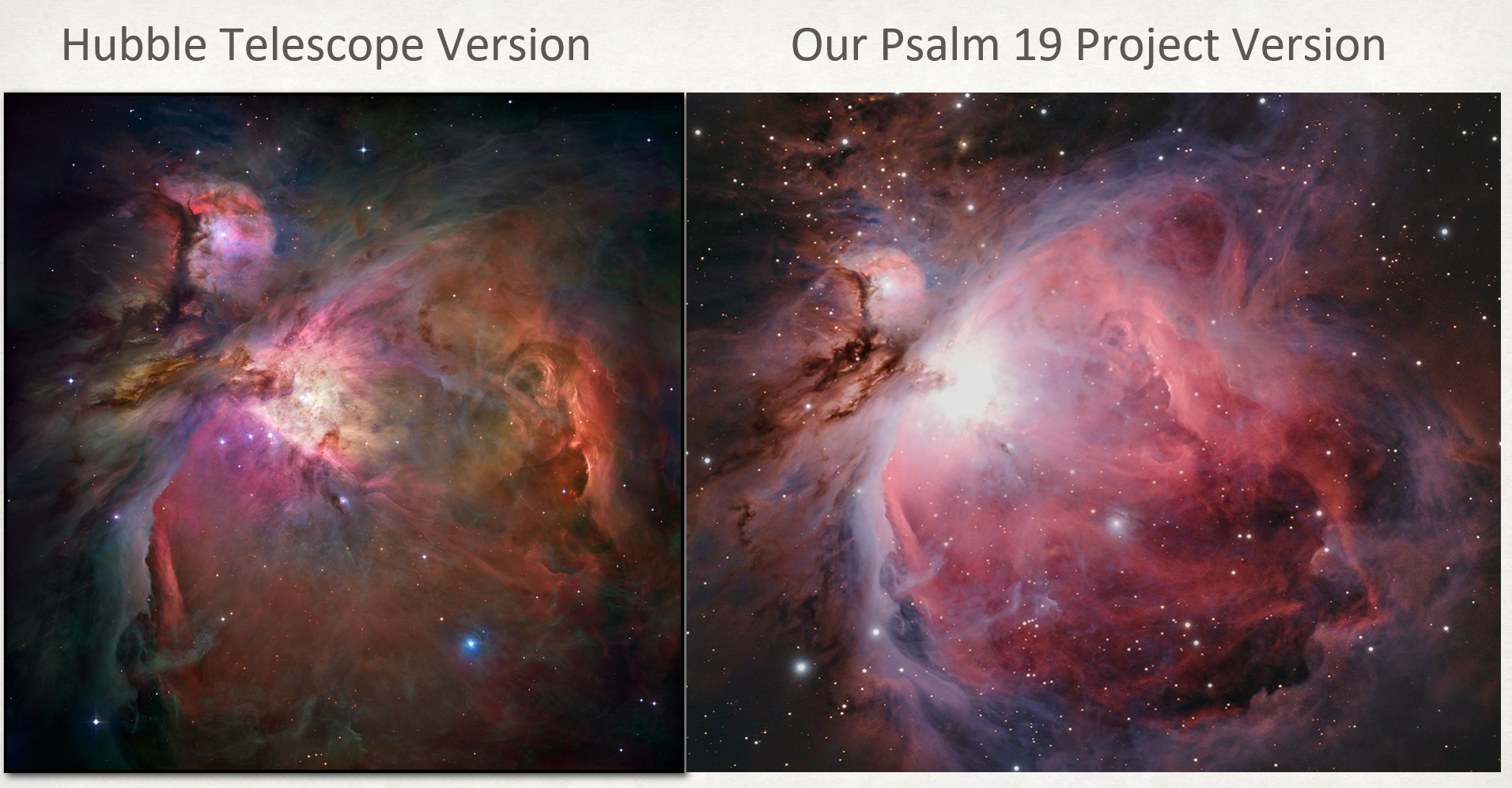
Let me give you one example about the current technology available to the amateur astronomer or astrophotographer. The image below contains a picture of the Orion Nebula on the left by the Hubble Space Telescope which cost around $16 billion. Obviously, our observatory did not cost even a small fraction of this, but the quality of our image is very nice. Now, granted, I like Hubble’s picture better, but ours did pretty good.

The picture above is our portable wide field setup. This is a Takahashi FSQ-85mm on a ZWO Harmonic drive mount with an ASI2400MC one shot color camera. The top telescope is a William optics 61mm Guidestar guide scope with it’s own ASI174MM camera for star guiding. It’s all operated through an ASI AIR PLUS mini computer connected to a tablet through WIFI.
Below is a behind the scenes video of how we take and produce these amazing images.
Below is a video of drone footage of our Roll Off Roof observatory which included our initial setup.
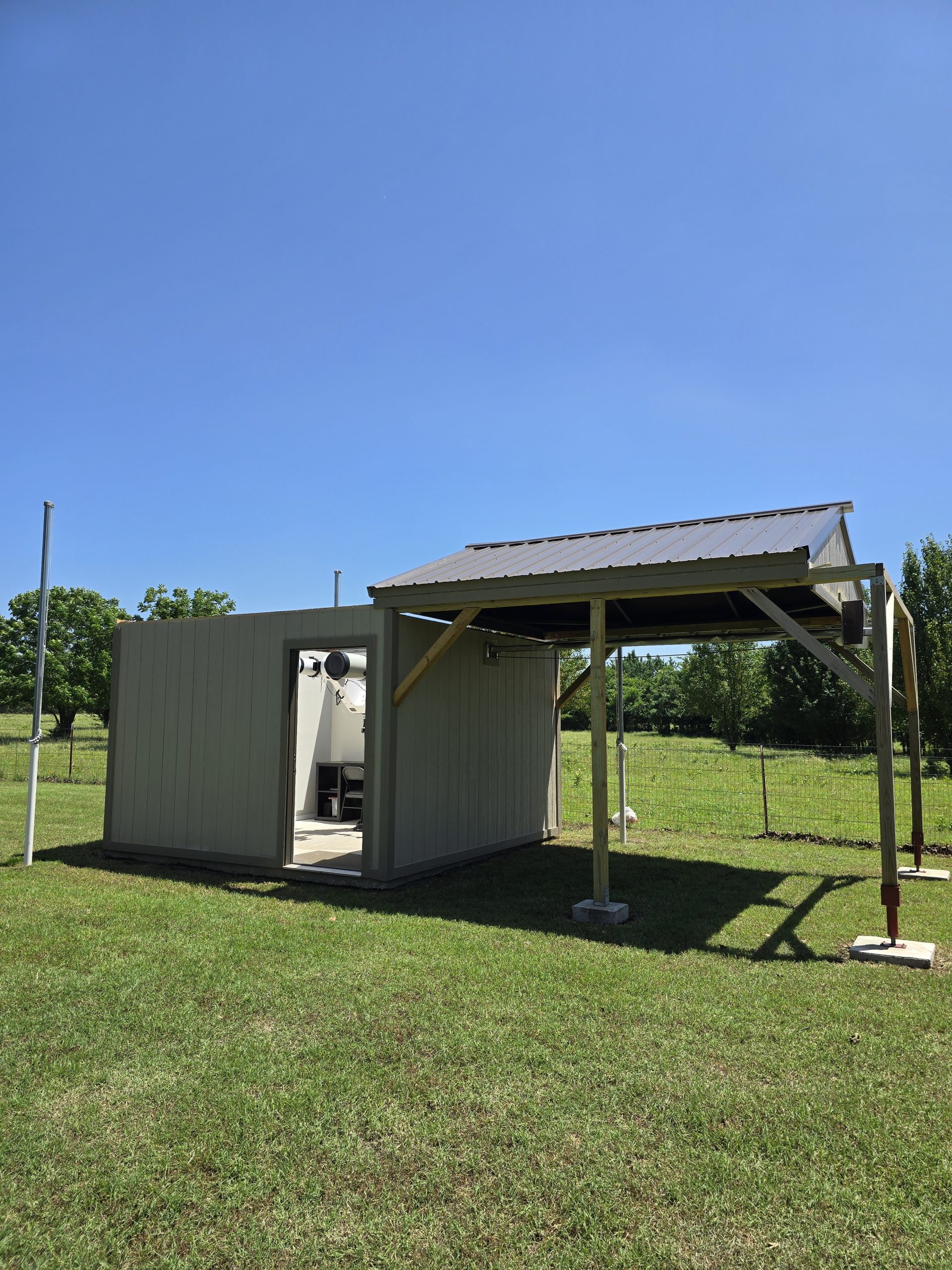


In mid 2026 we moved some of our best equipment (Stellarvue 7″ refractor and 85mm Takahashi refractor) to a super dark site in New Mexico at the Howling Coyote Remote Observatory (https://hcronewmexico.com/). Greg provides outstanding customer service, loves Jesus, and phenomenal dark skies. Here are a couple of pics of the setup.


The following are a sampling of the images we have been collecting with our equipment. There are literally millions upon millions of different targets and we are out collecting photons every clear night!


Above is a 12.5 hours of exposure time on our 6″ refractor of the Triangulum Galaxy from 2022. This galaxy is the farthest thing someone can see with their naked eye in a dark site. Over 2.7 million light years away. It is about half the size of our own Milky Way galaxy.
Click on image to enlarge. This was one of our earlier pictures and so we are getting more used to the equipment and taking better pictures now.
We took another picture of the Triangulum with our 180mm (7″) refractor below.

This is our new picture of the mighty Triangulum Galaxy with 33 hours of exposure time with our 7″ refractor. You can see the better quality between the two identical targets by simply adding extra time. (Click to enlarge and see the detail)


Above is Messier 13- The Hercules Cluster. 6 hours of exposure with our CDK12.5″ The Hercules has 300,000 stars in its 145 light year diameter at a distance of 22,000 light years away.
(click for higher resolution)
Below is another image we took of the Hercules cluster with our 7″ refractor from our brand new super dark sky site in New Mexico. We have our equipment at the Howling Coyote Remote Observatory which we highly recommend (https://hcronewmexico.com/). This was an 11 hour LRGB exposure of M13. (click for higher resolution and then zoom in!)

Below is another globular cluster in the constellation Hercules. This one is known as M92 and is 6 hours of exposure with our CDK 12.5″. There are over 330,000 stars in this cluster at 26,000 light years away and a 109 light year diameter. (click to enlarge)

Below is a third globular cluster called the Rose Cluster (Messier 5). These are unique objects which are located above and below the plane of our Milky Way Galaxy. This one has over 500,000 stars and is 22,500 light years away. The diameter of this cluster is around 165 light years! This image below was taken with our 7″ refractor for only a 3.6 hours exposure.
(Click to enlarge and zoom in!)


Above is the Pinwheel Galaxy (M101) taken over 19 hours withour CDK12.5″ (click for larger image)

Above is the Dumbbell Nebula in the constellation Vulpecula and is made up of 18 hours worth of exposure time. (Click to enlarge)

Above is the Elephant’s Trunk nebula in the constellation Cepheus. It is made up of 25 hours of exposure time. Taken with our 6″ refractor from the skies of Oklahoma. Below is an up close image of the specific “Elephant’s Trunk.” (Click to enlarge)


Above is the Whirlpool Galaxy in the constellation Canes Venatici made up of 51 hours of time exposure with our 7″ refractor from Oklahoma. (click to enlarge)
The picture below is of the Helix Galaxy (NGC 2685). It is around 40 million light years away and resides visually near the Big Dipper. I call it the Light Bulb Galaxy. It is known as a lenticular or polar ring galaxy. These types are pretty rare. (click to enlarge)

The Sun (our local star)

Above is an up close image of our sun with a Hydrogen Alpha eyepiece filter. Notice the prominences on the left launching up off the surface tens of thousands of miles.
The following image below was a pleasant surprise. I set out to image a target known as Stephan’s Quintet. A beautiful grouping of galaxies which look like they are getting ready to collide. Our astrophotography camera is a gigantic 62 megapixel. Plus the sensor is huge producing a 9500×6400 pixel frame. What this means is that it can image a large portion of the sky. Many of the targets we go after are quite small and dim which is why we try to get 15 or 20 hours of exposure time.
Well, after spending 17 hours targeting Stephan’s Quintet I noticed that there were all these little “smudges” in the full picture. (See below). But after zooming in, I realized that these were all galaxies! I counted over 50 of them in this single image. Can you find them all?
(click on the image to open high resolution quality and then you can zoom in and count the galaxies)

The image below is a zoom in on Stephan’s Quintet. A beautiful collection of almost colliding galaxies. So incredible! 16 hours of exposure time.
(Click on image for higher resolution)

After looking at the larger field of view image as seen above, I noticed the absolutely stunning galaxy on the right side of the image. What is amazing is that when we image we record the celestial coordinates. I can tell the computer to plate solve the coordinates and then annotate the image. It then identifies all the galaxies found in the image as compared to modern star catalogs. This image is called the Deer Lick galaxy group.
Remember that God simply created all these on a Wednesday (Genesis 1:14). Our God is truly beyond all powerful comprehension.
Deer Lick galaxy group below. (click image for higher resolution)

Below is a picture from the newly installed Stellarvue 6″ refractor in Idaho from our Psalm19 Project partner, Micah (countryastronomer.com for more of his pictures). This is nicknamed the Tadpole nebula (officially IC 410). You can click on this for a high resolution. Isn’t God an amazing Creator. His creativity is unlimited and there are billions of these objects. Truly His glory is on display for us to see. We just have to go out and take a picture of them! Wow!


Above is the Lion’s Head Nebula (also known as Sh2-132) by Micah Nowack from Idaho with over 21 hours of exposure.

This image above is the reflection Embryo Nebula (NGC 1333) in the constellation Perseus. This was taken with our 7″ refractor highlighting rich cloud fields of gas and also beautiful colors. What I find interesting and beautiful in its own way is the dark nebula which blocks out any star light from coming through. (click on image for higher resolution)

The Crab Nebula above is in the constellation Taurus. This is from a star exploding and going supernova. It is believed that the Chinese astronomers noted in their records that a star exploded which expanded outward producing this gaseous cloud. Taken with our 7″ refractor of 25 hours of exposure time. (click on image for higher resolution)
The winter in Oklahoma is cold, but we now have the observatory set up to be run remotely. This means that I can sit inside where it is warm and instruct the computer and telescope where to point and it will do as I command. We are living in amazing times with the technology that we have available to us.

The image above is the Andromeda Galaxy and took us 13 hours of exposure for this image. It is the closest galaxy to our own Milky Way galaxy and approximately 2.5 million light years away. It is around 150,000 light years wide and estimates are that it contains 1 trillion stars. The Milky is around 90,000 light years wide and contains approximately 100-400 billion stars. (Click on the image to enlarge)

The image above is known as the Double Cluster in the constellation Perseus. Have you wondered, “how many stars are there really in the sky?” In a dark site, you can see between 3-5,000 stars, but if you take a telescope and focus on one spot for 2 hours like we did in this image, you can see that every part of the sky is simply filled with stars. It is practically unlimited. (click on the image to enlarge)

The above image might look familiar. It also is the Orion Nebula, but a wider field of view than the picture shared way above. The original picture was taken with our 6″ refractor at 2 hours. This image here is from our 7″ refractor and was 3.75 hours. The extra size of the scope and time revealed even more fine structure and colors! Make sure to click on the image to see the details. Our cameras provide extremely high levels of resolution (64 megapixels) and this was an even larger field of view showing us even more beautiful structure.

The above reflection nebula is officially known as IC 2118 and is located just to the west of the massive star Rigel which is in the Orion constellation. It took us 20 hours to get all the pretty colors and its nickname is the Witch Head nebula… can you see why?

The image above is of the Pleiades star cluster, also known as the Seven Sisters in the constellation Taurus. This picture took 11 hours and is a unique rendition because the increased exposure time brought out the reddish gas on the left versus the typical blue only around the main stars in other pictures. We took this with our 7″ refractor. (Click for a larger image)
Spring is considered galaxy season where much of the larger and colorful nebulae are behind the sun, but galaxies abound in the night sky. It’s fun to wait for a dark, moonless long night and point the telescope at a relatively dark spot in the Virgo constellation. Depending on how big the telescope is and how long you take pictures of the same spot will determine how many galaxies show up in your picture. This area of sky below contains the Virgo cluster of galaxies which numbers around 1500. In this picture below, taken with our 7″ refractor, I counted over 70 and the few prominent galaxies here form part of what is called Markarian’s chain. Simply beautiful. Make sure and zoom in on the high resolution picture.

(Click on image to enlarge)
Below is another wide field of view picture that we took with our 7″ refractor. There are over 40 galaxies in this image. We are blown away that every one of these galaxies has hundreds of billions of its own stars (suns) like our own. Is it possible that God created life on any of these star systems? It is possible, but the Bible does not speak anything specific, but it is fun to wonder. This wide field image contains the Sombrero galaxy.

Below is a close up of the stunning Sombrero Galaxy (also know as M104- Messier 104). It was discovered in 1781 and is over 30 million light years away toward the Virgo constellation. This is 23 hours worth of exposure time and the picture rotated.


The Rosette Nebula above was an excellent December long night project in Oklahoma. This is 59 hours with our 180mm refractor. We usually aim for 25-30 hours, but since we did 59 this one has excellent, rich colors.
(Click for high resolution image.)

This picture above is the Helix Nebula (NGC 7293), sometimes called the “eye of God” in the constellation Aquarius. It is a planetary nebula which means a giant star “exploded” its outer shell and the gases become ionized into the various colors. Quite beautiful! This is a 28 hour exposure from the heavens above Oklahoma. (click to see full resolution and zoom in!)

This picture above is an 18.6 hour image which has several objects. You can see the dark nebula called the Horsehead nebula. Down to the left is the Flame nebula. All of these are in the constellation Orion from the skies of central Oklahoma.
(Click the picture for full resolution)
The image below is incredible! It is called the Bubble Nebula and was captured by our Psalm 19 Project partner out in Idaho. He has a 6″ refractor and this was 43 hours of exposure time. Make sure and zoom in to see the bubble!


The image above of the Western Veil Nebula was taken with our Stellarvue SVX152T (6”) refractor, RGB and narrowband filters, and a ZWO ASI6200MM monochrome camera. It was composed of 254 images for a total exposure time of 38 hours from our Idaho observatory. The rich colors are the result of a supernova explosion, with its glowing filaments of ionized hydrogen and oxygen creating intricate, wispy structures. (Click for high resolution)

The picture above is the Pelican Nebula, cataloged as IC 5070, and is a large, ionized gas region in the constellation Cygnus, resembling a pelican’s head and located about 1,800 light-years from Earth. This was 42 hours of exposure from central Oklahoma with our 7″ refractor. (Click for high resolution)
The image below is called the The Soul Nebula (Sh2-199) is found in the constellation Cassiopeia, about 6,000 light-years from Earth. This pictures was taken from our observatory in Idaho by our Psalm 19 Project colleage, Micah, with our Stellarvue SVX152T (6”) refractor, narrowband filters, and a ZWO ASI6200MM monochrome camera. It was composed of 145 images for a total exposure time of 24 hours. (click on the image for high resolution)

In addition to telescopes, a good old fashioned DSLR camera works wonders for comets. The image below is named Comet C/2023 A3 (Tsuchinshan-ATLAS). This image was taken near our Idaho observatory
with a Nikon D5300 camera and a 15-second exposure. (click on image for high resolution)

The picture below is an oustanding picture of the nebula known as Melotte 15, (also known as the Heart Nebula Cluster) located approximately 7,500 light-years away in the constellation Cassiopeia. This image was taken by Micah in Idaho with our Stellarvue SVX152T (6”) refractor, narrowband filters, and a ZWO ASI6200MM monochrome camera. Itwas composed of 208 images for a total exposure time of 34 hours. (click for high resolution image)


This picture above is called the Angel Nebula (NGC 2170) and is in the constellation of Monoceros, not too far from the Orion Constellation. It is a reflection nebula located around 2400 light years away.
This took 45 hours of exposure time on our 7″ Stellarvue refractor with a 6200MC one shot color camera. (click on it for a high resolution picture)

The Thor Nebula (NGC 2359) above is a cosmic masterpiece blazing in the constellation Canis Major. Shaped like a winged helmet, this dramatic bubble of gas is carved by fierce stellar winds from a rare Wolf-Rayet star at its core. Located about 12,000 light-years away, it glows with ionized hydrogen and oxygen, sculpted by shockwaves that ripple through surrounding space. This was taken from central Oklahoma skies with a ZWO 6200MC one shot color camer on our 7″ refractor over a period of many nights. This was 60 hours total exposure time! (click on it for a high resolution picture)

The picture above is the amazing Trifid Nebula (Messier 20) nestled in the constellation of Sagittarius. This area of gaseous nebulosity is around 5,000 light years away towards the center of our galaxy. The reds and pinks are ionized hydrogen gas and the beautiful blue color is scattered light from the nearby stars. This is only a 12 hour exposure with our 7 inch refractor from the skies of Oklahoma. (Click on the picture for high resolution)
Below is the The Cave Nebula. It is a diffuse emission, reflection, and dark nebula that is located in an HII region where new stars are actively formed. It is cataloged as Sh2-155 and Caldwell 9. The distinct cave structure of the nebula is about 10 light-years wide, and it is located roughly 2,400 light-years from Earth in the constellation Cepheus. This picture was taken with our Stellarvue SVX180T (7”) refractor in Oklahoma and ZWO 6200MC color camera for a total of 30 hours of exposure. (Click on the picture for high resolution)

Below is the amazing reflection nebula known as the The Ghost Nebula. Found in the constellation Cepheus, it is located about 1,470 light-years from Earth, and spans over 2 light-years across. The nebula shines with a faint, ghostly, yellowish-brown luminosity that comes from the dust scattering light of embedded stars. The Ghost Nebula is formed within a dense, collapsing cloud of gas known as a Bok Globule. This picture was taken with our Stellarvue SVX180T (7”) refractor in Oklahoma and ZWO 6200MC color camera for a total of 27 hours of exposure. If you look closely zoomed in on the middle, it looks like a person riding a nebula wave lifting his hands in praise to God the majestic creator! (Click on the picture for high resolution)

Below is the The Eagle Nebula (also known as M16). It is an emission nebula and open star cluster located 7,000 light-years away in the constellation Serpens, and spans roughly 70 x 55 light-years. This picture was taken with our Stellarvue SVX180T (7”) refractor in Oklahoma and ZWO 6200MC color camera for a total of 33 hours of exposure. (Click the image for high resolution)

The absolutely stunning image below is called the Fox Fur Nebula. It is an emission and reflection nebula that glows red from ionized hydrogen and blue from reflecting dust near hot, newborn stars. It is catalogued as NGC 2264 and Sh2-273. The Fox Fur Nebula is 30 to 50 light-years wide and is located 2,700 light years away in the constellation Monoceros (the Unicorn). This image was taken with our SVX152T (6”) Stellarvue refractor from our Psalm 19 collaborator Micah in the dark skies of western Idaho. It was captured with an ASI 6200mm camera, and was made from 278 exposures for a total of 46 hours exposure time. (Click image for high resolution)

Below is the The Crescent Nebula. It is an emission nebula and stellar wind bubble located in the constellation Cygnus. It is catalogued as NGC 6888 and Caldwell 27. The cosmic bubble spans about 25 light-years across, and is located roughly 5,000 light-years from Earth. The Crescent Nebula is energized by a massive, dying Wolf-Rayet star, and will eventually end in a supernova explosion. This image was taken with our SVX152T (6”) Stellarvue refractor by Micah in Idaho, with narrowband Antlia filters, and a ASI 6200mm camera, and was made from 283 exposures for a total of 47 hours exposure time. It looks kinda like a brain! God is amazing in His creativity. (Click picture for high resolution)

Articles in the Psalm 19 Project series:
Part 1- What is the Psalm 19 Project
https://prophecywatchers.com/the-psalm-19-project/
Part 2- Addressing Flat Earth Claims
https://prophecywatchers.com/psalm-19-project-addressing-flat-earth-claims/
Part 3- What is the Expanse/Firmament (Raqia)?
https://prophecywatchers.com/psalm-19-project-what-is-the-expanse-firmament-raqia/